A boat trailer can look perfectly suitable on paper and still be wrong for the job.
The length may match. The weight rating may look generous. The frame may be in good shape. Yet once the boat is sitting on it, something feels off. The supports are not where they need to be. Maneuvering takes more effort than expected. Loading is awkward. Or the trailer works fine on a flat driveway but becomes a headache every time it enters a busy boatyard.
That is because choosing a trailer is not only about the boat.
It is about how the boat will be moved, where it will be moved, how often it will be moved, and what the trailer needs to do when the conditions are less than ideal.
A Trailer Should Match the Job
A trailer used occasionally to move a small recreational boat has a very different life from one working every day in a commercial boatyard.
The first might spend most of its time parked, then make a few trips to the ramp during the season. The second may spend its days moving vessels around a crowded yard, positioning boats for storage, maintenance, repairs, or launching.
Treating those two applications as essentially the same job is where trailer selection can go sideways.
For a boatyard, maneuverability and hull support can become just as important as basic capacity. A yard trailer needs to work within the physical realities of the property, including tight spaces, uneven surfaces, changing boat loads, and the constant movement of other equipment.
For a recreational owner, roadworthiness, towing setup, corrosion resistance, brakes, lights, tires, and overall condition may deserve more attention.
Bigger Is Not Automatically Better
There is a temptation to buy more trailers than necessary because extra capacity sounds like extra safety.
It is not quite that simple.
A trailer needs enough capacity for the actual boat and its load, but an oversized piece of equipment can introduce its own problems. It may be harder to maneuver, take up more storage space, or simply be unnecessary for the way the boat is used.
This is particularly relevant when looking at used small boat trailers for sale. A smaller trailer that is properly matched to the hull, weight, and towing requirements can be a far better purchase than a larger trailer that does not suit the boat.
The goal is not to buy the biggest thing available.
The goal is to buy the right thing.
Hull Support Is Where the Real Fit Happens
Two boats with similar dimensions can still sit very differently on a trailer.
Hull shape matters. Weight distribution matters. Keel configuration matters. So does the location and type of support the boat actually needs.
That is one reason custom equipment makes sense for boatyards handling a range of vessels.
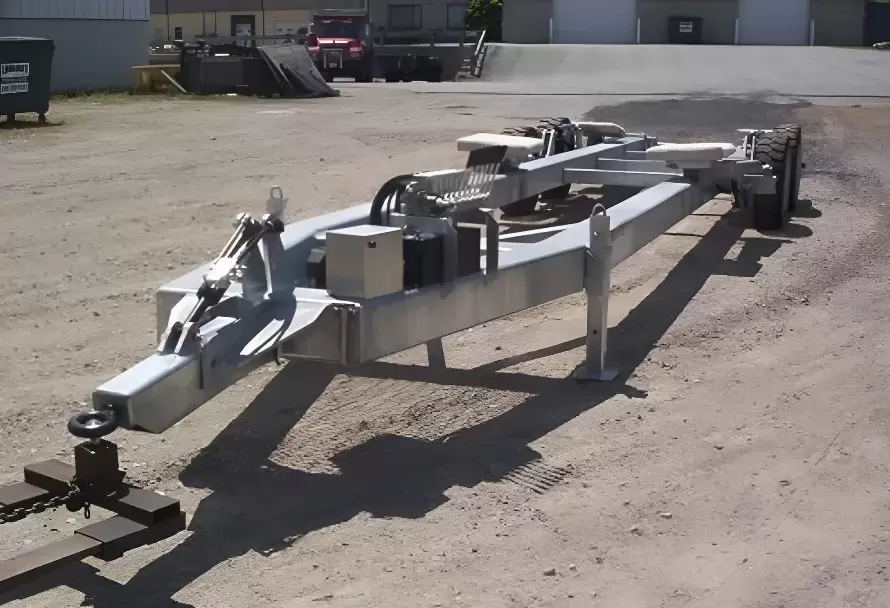
Minuteman Boat Handling Equipment builds yard trailers in different capacities and configurations, with options ranging from 20,000-pound to 100,000-pound capacities and support-arm configurations that change with the trailer size.
The important point is not the numbers themselves.
It is the idea behind them: the trailer is built around the handling requirement rather than forcing every boat into one standard setup.
That becomes especially valuable when a yard deals with vessels that vary substantially in size, shape, and weight.
Custom Makes More Sense When the Work Is Specific
A custom trailer is not automatically better just because it is custom.
The reason to go custom is that the application has requirements a standard trailer does not handle particularly well.
Maybe the yard routinely moves heavier vessels. Maybe the available space requires a particular overall length. Maybe the support arrangement needs to accommodate a certain type of hull. Maybe the trailer will spend its life doing repetitive work that a general-purpose unit was never designed around.
Those are the situations where customization becomes practical rather than decorative.
Minuteman describes its yard trailers as equipment designed around specific boat-handling requirements, with custom configurations available for different vessel sizes and capacities.
For a commercial operation, that distinction matters because trailer downtime is not just an inconvenience. It can interfere with the work happening around it.
Used Does Not Mean “Settling”
There is also a tendency to think of a used trailer as the budget option you choose only when a new one is out of reach.
That is not always true.
A well-maintained used trailer can make plenty of sense for an owner whose needs are straightforward. The key is condition, not the word “used.”
Look at the frame. Check for corrosion. Inspect the axles, tires, bearings, brakes, lights, welds, and other components that determine whether the trailer is actually ready to work.
Minuteman says its new and used trailers are checked across areas including the frame, axles, tires, bearings, lights, and brakes before being offered to customers.
That kind of inspection changes the conversation. You are not simply asking how old the trailer is. You are asking what condition it is in and what work it can realistically handle.
Think About Where the Trailer Will Live
Boats spend their lives around water, and trailers pay the price.
Salt, moisture, spray, mud, grit, and changing weather conditions are hard on metal and moving components. A trailer that looks fine from ten feet away can tell a different story when you inspect the areas that actually carry the load.
Corrosion resistance therefore deserves more attention than it usually gets.
Minuteman offers galvanized boat trailers, using a zinc coating intended to protect the trailer from rust and corrosion.
For a trailer that will regularly operate around marine environments, that is not an aesthetic consideration. It is part of thinking about how the equipment will age.
The Best Trailer Is the One You Stop Fighting
There is a useful test for any trailer purchase:
Does the equipment make the job easier, or are you constantly working around it?
A good trailer should not require everyone on the property to develop a collection of tricks just to make it usable.
The supports should make sense. The capacity should match the work. The equipment should maneuver in the spaces where it actually operates. A recreational trailer should tow appropriately for its intended use. And a used trailer should have enough life left in the components that matter.
That is ultimately what separates a good match from a technically acceptable one.
Whether you are comparing custom boat yard trailers for sale for a working marine facility or looking through used small boat trailers for sale for a smaller vessel, start with the job instead of the sales listing.
Think about the boat.
Then think about everything that happens around the boat.
That is usually where the right trailer becomes obvious.
FAQs
1. How do I choose the right boat trailer?
Consider the boat’s weight, hull design, dimensions, towing requirements, and how the trailer will actually be used.
2. Are used boat trailers worth buying?
Yes, if the trailer is in good condition and its frame, axles, tires, brakes, bearings, and other components have been properly inspected.
3. Why are custom boat yard trailers useful?
Custom trailers can be built around specific vessel sizes, weights, hull configurations, and boatyard handling requirements.
4. What should I check on a used small boat trailer?
Inspect the frame, welds, axles, tires, bearings, brakes, lights, and signs of corrosion before purchasing.
5. What makes a trailer suitable for a boatyard?
Capacity, maneuverability, hull support, durability, and compatibility with the yard’s working conditions all matter.